
Key facts: Soot Removal
- Soot is a mix of fine carbon particles and chemical residues; its makeup depends on what burned and how hot the fire was.
- Dry, powdery soot is usually removed with dry methods first, because water can smear it and set the stain.
- Oily soot from plastics and cooking fats needs a degreasing step and is harder to remove from porous surfaces.
- Fine combustion particles can irritate the lungs, so protective equipment matters during cleanup.
- The IICRC S700 document sets out recognised practice for cleaning up after fire and smoke in the United States.
What soot is
What actually lands on your walls after a fire
When something burns without enough oxygen to consume it completely, part of the fuel leaves as tiny unburned carbon particles. Those particles ride the hot gases of the fire, cool as they travel, and settle on whatever surface they reach first. That deposit is soot. Mixed into it are tars, acids and other chemical by-products, and the exact recipe changes with every fire because it depends on what was burning.
A cotton couch, a stack of cardboard, a vinyl window blind and a pan of cooking oil each leave a different residue. Natural materials burning hot tend to leave a dry, fluffy powder. Synthetic materials such as plastics, foams and carpet fibres smoulder into a sticky, smeary film. Kitchen fires involving meat and fats leave an almost invisible yellowish residue with a powerful smell. Most real house fires burn several kinds of material at once, so a single room can carry more than one type.
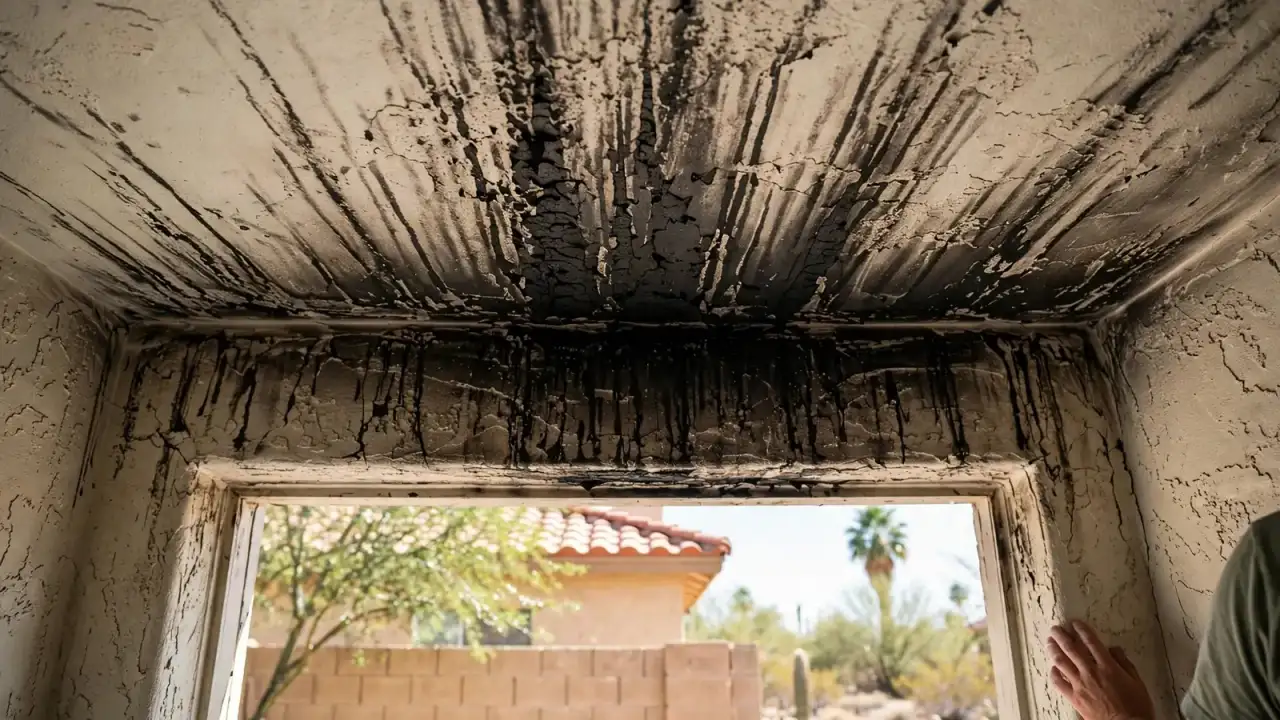
Soot also does not stay where the fire was. Hot air rises and spreads, so the heaviest deposits are often on ceilings and the upper third of walls well away from the burned area. It is pulled toward cooler surfaces, which is why you can see dark outlines of ceiling joists, shadow lines behind pictures and dark streaks around doors where air was moving. In a Phoenix home with the air conditioning running when the fire started, the return air system can carry fine particles through every room the ducts serve. [1]
Understanding these patterns is the first job in soot removal. A restoration technician reads the deposits to work out where air moved, which surfaces took the worst of it, and which cleaning method each surface will tolerate. That reading decides whether the room can be cleaned or whether materials have to come out.
Soot types
The four residues a technician looks for
Each type is cleaned differently. A quick test with a dry sponge in an out-of-the-way spot tells a lot about which one you have.
Dry, powdery soot
Left by fast, hot fires burning paper, wood and natural fibres. It sits loosely on the surface and can often be lifted with dry sponges and HEPA vacuuming before any liquid is used.
Wet, oily soot
Left by slow, smouldering fires in plastics, rubber and foam. It smears when touched, bonds to paint and needs a degreasing cleaner. It is the type most likely to stain permanently.
Protein residue
Left when food burns on the stove. Nearly invisible, yellow to brown, with a sharp, lingering smell. It discolours paint and varnish and needs specific cleaners to break it down.
Fuel oil and appliance soot
Left by a malfunctioning fuel-burning appliance that puffs back. It is less common in Phoenix homes, which mostly use electric or gas heat, but it does occur with older gas furnaces and water heaters.
Why it spreads
Why soot travels far beyond the burned room
People are often surprised to find soot in a back bedroom when the fire was in the kitchen. Three forces explain it. Heat pushes smoke up and outward under pressure, forcing it through gaps under doors, around light fixtures and into wall cavities. Air handlers, ceiling fans and open windows keep it moving. And fine particles, small enough to stay suspended for hours, drift until they settle on cooler surfaces.
Desert homes add a few local wrinkles. Many Phoenix houses keep windows closed most of the year and run forced-air cooling continuously, so the duct system is the main highway for smoke. Homes that still use evaporative coolers move large volumes of outside air through the house, which can carry smoke from a neighbour's fire or a brush fire on a mountain preserve edge into rooms that never saw flames. Attic spaces are hot and often loosely sealed at the top plates, letting smoke move above the ceiling and drop back through can lights and attic hatches.
Electrical charge plays a part too. Soot particles can pick up a static charge and cling to plastic surfaces, electronics and synthetic fabrics. That is why a television screen or a vinyl window frame in an unburned room may show a fine grey film. It is also why simply dusting does not remove it: the particles are holding on.
All of this matters for cleanup because a restoration plan has to follow the smoke, not the flames. A contractor will usually check every room, the attic, closets, cabinets and the HVAC system before deciding what needs cleaning, rather than assuming the damage stops at the burned walls.
Testing
How a technician tests soot before cleaning
These checks take minutes but prevent the most common cleaning mistakes.
- 1
Dry sponge test
A dry chemical sponge is drawn across a small, hidden patch. If the soot lifts cleanly onto the sponge, it is mostly dry residue. If it smears or barely moves, it is oily or bonded.
- 2
Surface check
The technician notes whether the surface is flat paint, gloss paint, bare drywall, textured ceiling, wood, stone or fabric, because porosity decides how deep the residue went.
- 3
Wet test in a hidden spot
A mild cleaner is tried on a small area to see whether it removes residue or spreads it. Some surfaces bleed colour or swell when wet.
- 4
Odor and pH check
Strong odor and acidic residue suggest the surface needs more than cleaning. Acidic soot can etch metals and stone if left in place.
- 5
Decide clean or remove
If a test patch cleans back to an acceptable finish, cleaning proceeds. If not, the material may need sealing and painting, refinishing or replacement.
Diagnosis
What the residue tells you
| What you see | Likely cause | Usual first step |
|---|---|---|
| Grey powder that wipes onto a finger | Fast, hot fire in natural materials | HEPA vacuum and dry sponge |
| Black film that smears when touched | Smouldering plastics, foam or rubber | Degreasing cleaner after a dry pass |
| Yellow-brown sticky film in the kitchen | Burned food (protein) | Enzyme or protein-specific cleaner |
| Dark lines tracing ceiling joists | Cooler framing pulled particles | Clean, then seal and repaint |
| Grey haze on screens and plastics | Charged fine particles | Gentle electronics-safe cleaning |
| Black rings around vents | Smoke moved through the duct system | Duct inspection and cleaning |
The process
How soot removal is done room by room
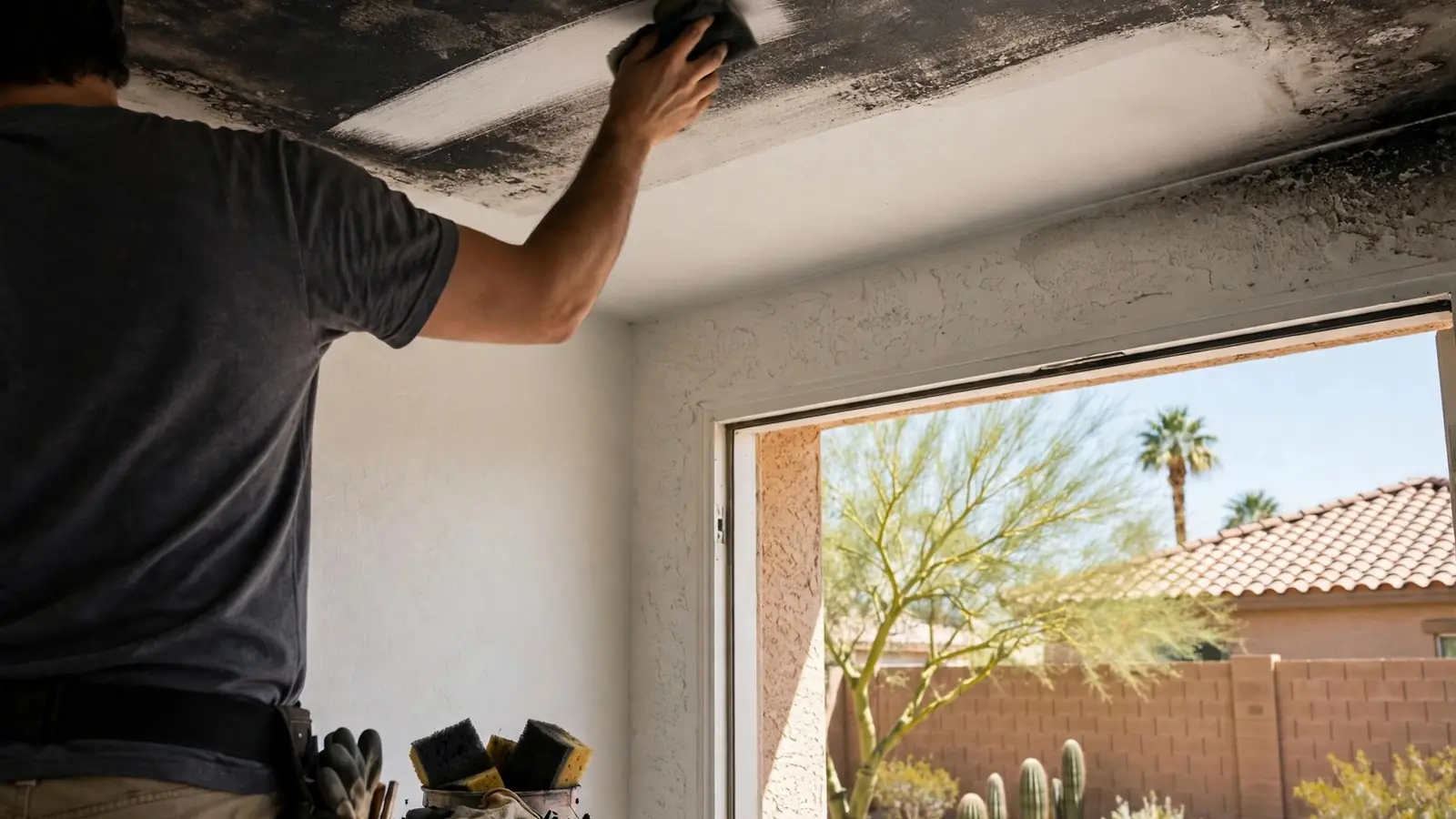
Good soot removal works from the top down and from dry to wet. Ceilings come first so that residue falling during cleaning lands on surfaces not yet cleaned. Loose particles are vacuumed with HEPA-filtered equipment, which captures fine particles instead of blowing them back into the room. Dry chemical sponges, made of vulcanised rubber, are then drawn across walls and ceilings in long strokes; they pull residue into the sponge rather than smearing it.
Only after the dry pass does liquid cleaning start. Technicians choose a cleaner based on the residue: alkaline detergents for most smoke films, solvent-based degreasers for oily soot, and enzyme products for protein residue. The cleaning solution is applied, given a short dwell time, wiped and rinsed. Painted walls are usually cleaned before any decision is made about repainting, because paint applied over residue may fail to bond and the smell can bleed through.
Contents are handled separately. Hard items such as dishes, ornaments and tools are cleaned by hand or in ultrasonic tanks. Clothing and soft furnishings go to cleaning methods suited to smoke. Electronics are not powered on until inspected, because residue on circuit boards can conduct electricity and corrode connections. Items that cannot be cleaned back to a usable state are documented for the insurance claim before disposal.
Once surfaces are clean, any remaining staining or odor is dealt with by sealing. A shellac-based or specialty primer locks in residual stain and odor before repainting. This step is common on ceilings and on unpainted wood such as roof sheathing and framing in the attic.
Methods
Soot removal methods compared
| Method | Best for | Not suited to |
|---|---|---|
| HEPA vacuuming | Loose dry soot on any surface | Bonded oily film |
| Dry chemical sponge | Flat paint, ceilings, wallpaper | Heavy grease or textured popcorn ceilings |
| Alkaline detergent wash | Gloss paint, cabinets, hard surfaces | Bare wood, unsealed stone |
| Solvent degreaser | Oily soot on hard surfaces | Some plastics and finishes |
| Enzyme cleaner | Protein residue in kitchens | Heavy carbon soot alone |
| Soda or dry-ice blasting | Charred framing and attic wood | Finished living-space surfaces |
| Ultrasonic cleaning | Small hard contents | Electronics with batteries, porous items |
Do it yourself?
What you can safely do before help arrives
There are a few things a homeowner can do safely, and many more that make the job harder. The useful steps are about limiting spread: keep traffic out of affected rooms, lay down old sheets on clean floors in walkways, and switch the thermostat fan off so the air handler does not keep circulating particles. Change the HVAC filter once the fire department has cleared the building, and do not run the system until it has been checked.
The steps to avoid are the instinctive ones. Scrubbing a sooty wall with a wet rag and household cleaner almost always smears residue deeper into the paint. Running a household vacuum without a HEPA filter blows the finest particles back into the air. Washing smoky clothes in a home washer can transfer odor to the machine. Plugging in electronics that sat in smoke risks short circuits.
- Turn the HVAC fan off
- Do not wet-wipe soot
- Do not use a regular vacuum
- Do not power on electronics
- Photograph everything first
The visit
What happens when a soot cleanup crew arrives
Most restoration contractors start with a walk-through. They will ask where the fire started, how long it burned, whether the fire department used water, and whether the air conditioning was running. They will look at every room, not just the burned area, and often take photographs and moisture readings. This is the moment to point out anything you have noticed: a smell in a closet, a grey film on a bathroom mirror, black rings around ceiling vents.
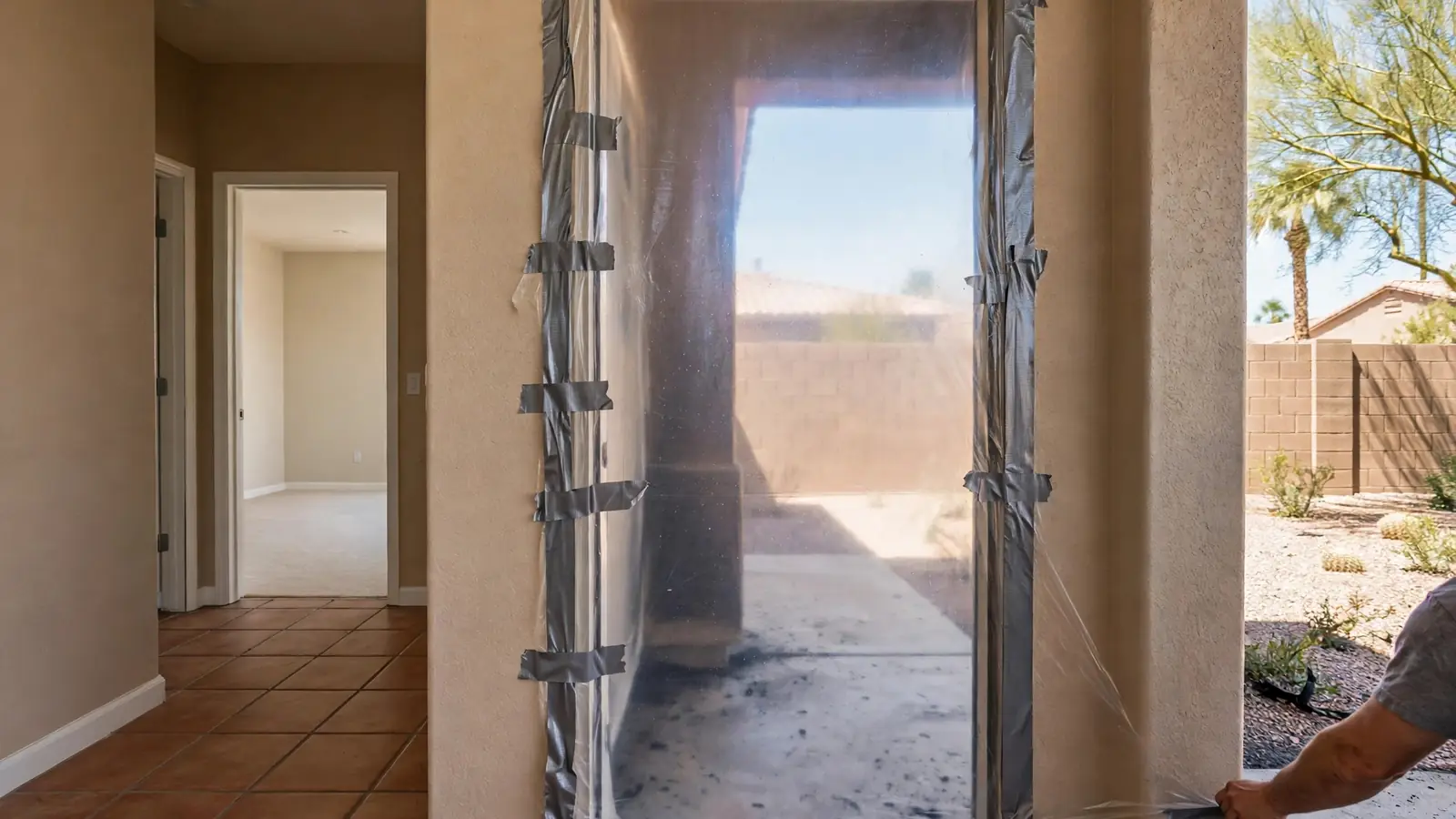
Next comes protection. Clean areas are sealed off with plastic sheeting, floors in walkways are covered, and air scrubbers with HEPA filters may be set up to capture particles stirred up during cleaning. Contents that are salvageable may be packed out to a cleaning facility so the structure can be worked on, or cleaned in place if the damage is light.
The cleaning itself follows the top-down, dry-to-wet order described above. A crew will typically finish one room before moving to the next so that clean rooms are not recontaminated. At the end of each stage, the contractor should be able to show you test areas and explain what still needs sealing, painting or replacement.
Because the arrangement is between you and the contractor, ask on the call how they document their work. Photographs before and after each room, a list of items cleaned and items discarded, and moisture readings where water was used all help with an insurance claim.
Phoenix specifics
Soot cleanup in a Phoenix house
The desert climate shapes soot cleanup in a few practical ways. Extreme summer heat in closed-up homes makes residues soften and odors intensify, so smoke smell often gets worse in the days after a summer fire rather than better. Houses left without power or air conditioning after a fire can reach very high indoor temperatures, which bakes residue into surfaces and makes prompt cleaning more valuable.
Construction style matters as well. Much of Phoenix housing is wood frame with stucco exterior, drywall interiors and textured ceilings. Knock-down and popcorn textures trap soot in their peaks and valleys and are hard to clean; restoration crews often have to decide between careful cleaning and retexturing. Older homes in areas such as Maryvale and Arcadia may have block walls and plaster in places, which handle cleaning differently from drywall. Some ceilings in homes built before the 1980s may contain asbestos, and disturbing them requires testing first. [5]
Phoenix homes also lean heavily on ductwork. Flexible duct runs in hot attics can absorb smoke odor and soot. If smoke reached the return air, the duct system usually needs inspection and cleaning as part of the soot job, otherwise residue recirculates the first time the air conditioning runs.
Dust is a factor too. Desert dust settling on top of soot residue creates a gritty mix that scratches surfaces when wiped. Crews often vacuum more thoroughly before wiping in Phoenix homes for this reason.
Prevention
Reducing soot problems in the future
You cannot prevent every fire, but you can limit how far soot travels and how hard it is to clean.
- Upgrade HVAC filtersA higher-rated pleated filter, changed on schedule, captures more fine particles during everyday use and after small incidents.
- Keep cooking attendedUnattended cooking is a leading cause of home fires. Staying in the kitchen while frying or broiling prevents most protein-residue fires.
- Maintain fuel-burning appliancesHave gas furnaces and water heaters checked so they burn cleanly and do not puff back soot.
- Store plastics carefullyGarages packed with plastic storage bins, paint and chemicals produce heavy oily soot if they burn. Keep them away from heat sources.
- Know where to shut off the air handlerBeing able to switch off the HVAC fan quickly limits how far smoke spreads during an incident.
Clean or replace
When cleaning is enough and when materials come out
The decision rests on how deep the residue went and whether the material is still sound. Non-porous surfaces such as glass, glazed tile, metal and sealed countertops can almost always be cleaned. Painted drywall can usually be cleaned and then sealed and repainted if staining remains. Textured ceilings, unsealed wood, grout and fabrics are less forgiving.
Materials that were heat damaged, warped, blistered or charred are normally removed regardless of how they clean. Insulation that took heavy smoke is generally replaced, since it holds particles and odor. Carpet and pad near the fire, or soaked by firefighting water, are often removed. A contractor should explain each removal decision and photograph the material before it leaves the house.
Related problems
Problems that usually come with soot
Lingering smoke odor
Smell can persist after visible soot is gone because odor molecules sit inside porous materials. See odor removal.
Read moreWater from firefighting
Hose water soaks drywall, insulation and flooring and must be dried before soot cleaning is finished.
Read moreSmoke damage to contents
Clothing, upholstery and electronics need their own cleaning methods.
Read moreOpenings in the structure
Broken windows and vent holes cut by firefighters need boarding up to keep dust and weather out.
Read more
FAQ
Soot removal questions from Phoenix homeowners
Can I wash soot off my walls myself?
Light, dry soot on a small area can sometimes be lifted with a dry chemical sponge. Wet-wiping usually smears it. For more than a small patch, or any oily residue, professional cleaning is the safer choice.
Why is there soot in rooms the fire never reached?
Smoke travels under pressure through gaps, wall cavities and the duct system, and fine particles drift until they settle on cooler surfaces. Rooms far from the fire are often affected.
Will painting over soot fix it?
Not on its own. Paint may not bond to residue, and stain and odor can bleed through. Surfaces should be cleaned first and then sealed with a suitable primer before repainting.
Is soot dangerous to breathe?
Fine combustion particles can irritate the lungs and aggravate asthma and heart conditions. Limit time in affected rooms and use a properly fitted N95 respirator if you need to enter.
Can my clothes be saved?
Many can. Smoke-affected clothing often responds to professional laundering or dry cleaning methods designed for smoke. Items that were scorched or melted usually cannot be saved.
Do the air ducts need cleaning after a fire?
If smoke reached the return air or the system was running during the fire, ducts usually need inspection and cleaning. Otherwise soot recirculates when the system runs.
How long does soot removal take?
It depends on the size of the home and how far soot spread. A contractor can give you a realistic timeline after the walk-through.
What is the IICRC S700?
The S700 is an industry document from the Institute of Inspection, Cleaning and Restoration Certification describing how cleanup after fire and smoke damage should be carried out. You can ask a contractor whether their technicians work to it.