
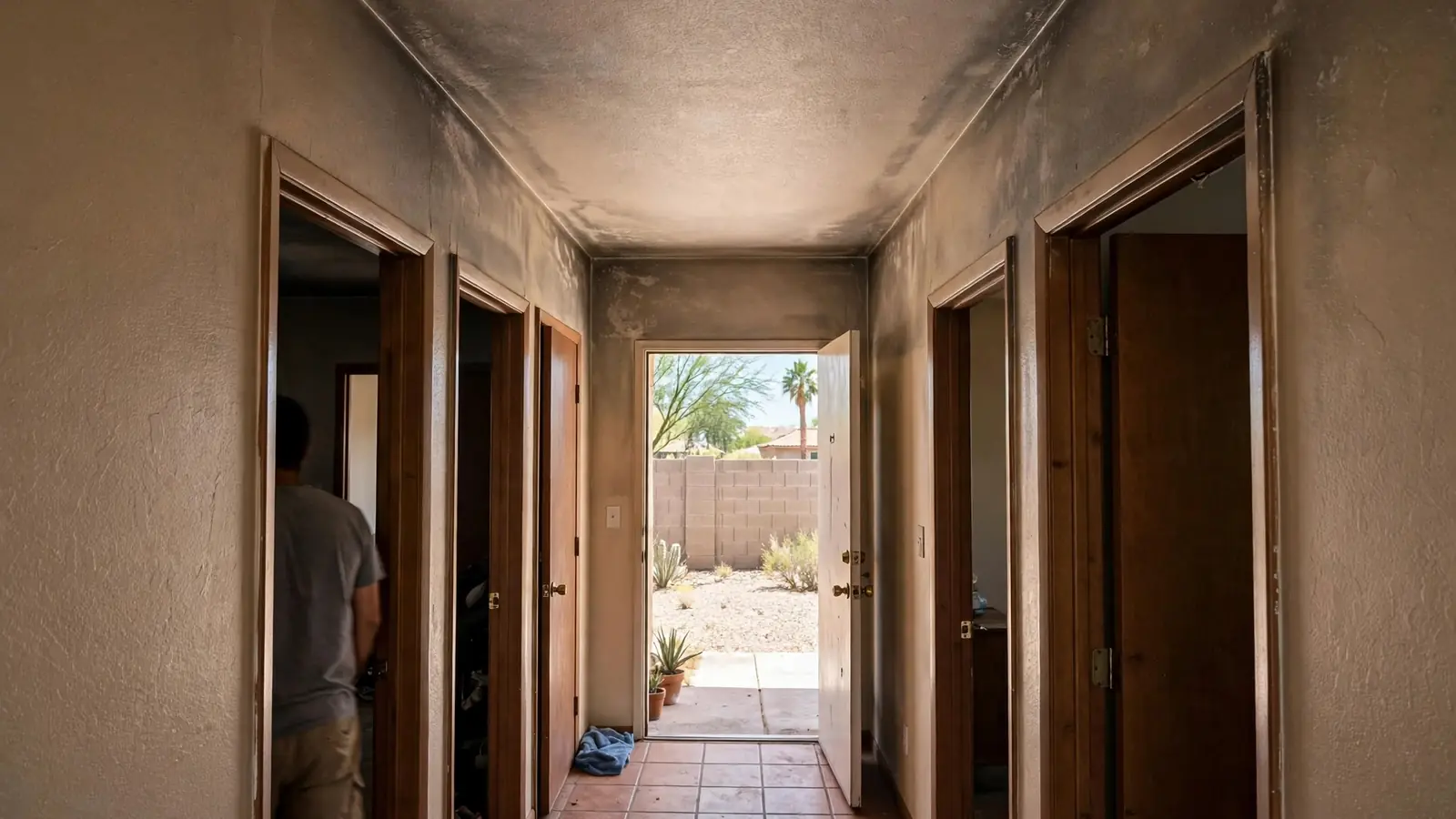
Key facts: Smoke Damage Cleanup
- Smoke is a mixture of gases and fine particles; the particles are the main source of visible residue and many health effects.
- Smoke moves with heat and air pressure, so it reaches rooms, closets and cavities far from the flames.
- Forced-air heating and cooling systems running during a fire can spread smoke to every room they serve.
- Acidic smoke residue can discolour and corrode surfaces such as metal fixtures and stone if it is left in place.
- The American Red Cross advises not to re-enter a fire-damaged home until the fire department says it is safe.
What smoke does
How smoke damages a home
Smoke is the airborne part of a fire: hot gases carrying fine solid and liquid particles. As it cools, the particles fall out of the air and coat surfaces, and the gases leave behind their smell. The combination is what restoration contractors call smoke damage. It differs from fire damage, which means materials that actually burned, charred or melted, and from soot, which is the heavier black carbon residue closest to the source.
The damage smoke does falls into three categories. There is visible discolouration, from a light grey haze on white paint to yellow staining on ceilings and cabinets. There is odor, which can soak into drywall, insulation, wood, carpet and upholstery and keep releasing for months. And there is chemical damage, because smoke residue is often acidic and can etch glass, pit chrome and brass, discolour grout and stone, and corrode electrical contacts.
Time works against you. In the first hours, residue sits on top of surfaces and is relatively easy to remove. Over the following days, acidic residue begins to react with what it sits on. Plastics and appliance finishes can yellow permanently, metals tarnish, and painted walls take on a stain that cleaning cannot fully lift. In hot Phoenix homes with the power off, this process speeds up.
That is why smoke damage cleanup is about speed and thoroughness. The aim is to find every place smoke went, clean or remove what it touched, and neutralise odor at its source rather than masking it.
Warning signs
Signs smoke reached more of the house than you thought
Walk the whole home, including rooms with closed doors, and look for these clues.
Grey shadows above doors and vents
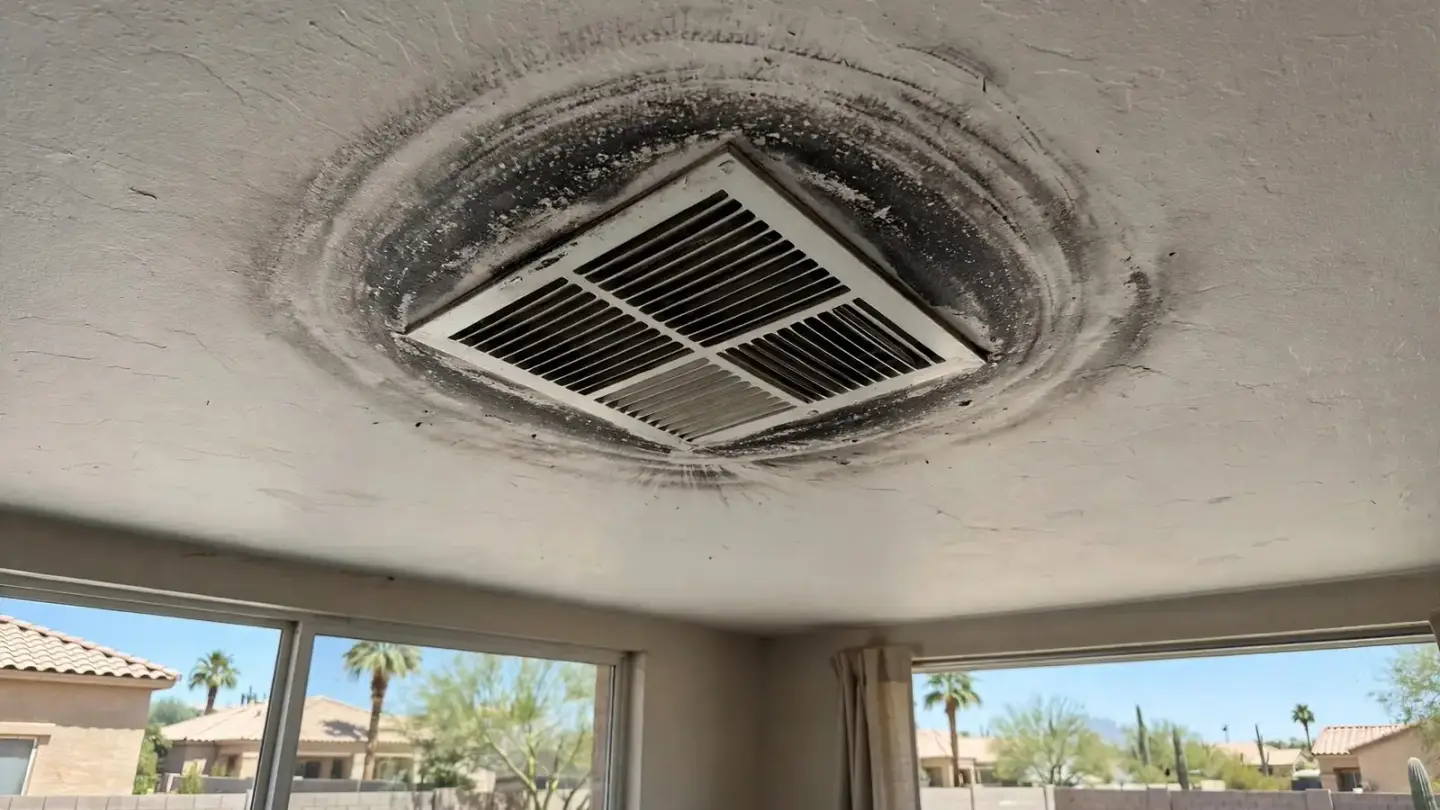
Smoke follows air movement. A darker band at the top of a door frame or ring around a ceiling register shows where it flowed.
A smell in closed closets
Clothing and linens absorb smoke even behind a closed door. If a closet smells, its contents probably need cleaning.
Film on mirrors and windows
A faint grey or oily film on glass in a distant bathroom is a sign smoke particles spread through the home.
Yellowed light switch plates and outlets
Plastic picks up smoke residue easily. Discolouration on white plastic is a common early sign.
Odor when the AC runs
If smell gets stronger when the air conditioning starts, smoke has likely contaminated the ducts or air handler.
Dark outlines on ceilings
Lines that trace joists or nail heads show particles settling on cooler spots and indicate smoke in the ceiling plane.
Why it lingers
Why smoke residue is so stubborn
Smoke particles are extremely small, many of them a fraction of the width of a human hair. Particles that small slip into pores in drywall, the grain of wood, the weave of fabric and the cells of foam. Once inside, they are not reached by surface wiping. They also carry odor compounds that slowly off-gas, which is why a room can look clean but still smell.
Temperature makes it worse. Heat opens the pores of materials during a fire, and smoke is drawn in. As the house cools the pores close, trapping residue. When the house heats again, which in Phoenix happens every afternoon for much of the year, the trapped compounds release and the smell returns. Many Phoenix homeowners notice smoke odor peaking in the late afternoon for exactly this reason.
Synthetic materials add their own problem. Modern furnishings contain a lot of plastic and foam, and when these burn they produce dense, oily smoke that sticks. Homes with a lot of synthetic upholstery, carpet and electronics tend to have heavier, more persistent smoke damage than older homes furnished with natural materials.
Assessment
How a contractor maps the smoke path
Before cleaning starts, a good contractor works out where the smoke actually went.
- 1
Start at the origin
The burned area shows how hot and how long the fire burned, which hints at the type and amount of smoke produced.
- 2
Follow the airflow
Technicians trace smoke lines along ceilings, under doors and around openings to see how it moved through the house.
- 3
Check closed spaces
Closets, cabinets, drawers, the attic and wall cavities near the fire are opened and inspected.
- 4
Inspect the HVAC system
Return grilles, filters, the air handler and accessible duct sections are checked for residue and odor.
- 5
Test surfaces
Wipe tests on different finishes show which ones will clean and which will need sealing or replacement.
- 6
Record what was affected
Each affected area and item is photographed and listed, which supports an insurance claim later.
Diagnosis
Smoke clues and what they suggest
| Clue | What it suggests | Likely response |
|---|---|---|
| Light haze only in rooms near the fire | Limited spread, short fire | Surface cleaning of those rooms |
| Haze and odor throughout the home | Smoke moved through the HVAC system | Whole-home cleaning plus duct cleaning |
| Strong smell inside closed cabinets | Smoke under pressure entered closed spaces | Empty and clean cabinets and contents |
| Smell strongest in the afternoon | Odor trapped in porous materials | Deodorisation and sealing |
| Pitted or tarnished fixtures | Acidic residue sat too long | Specialist cleaning or replacement |
| Odor in the attic | Smoke in insulation and roof wood | Insulation removal and wood sealing |
The process
How smoke damage cleanup works
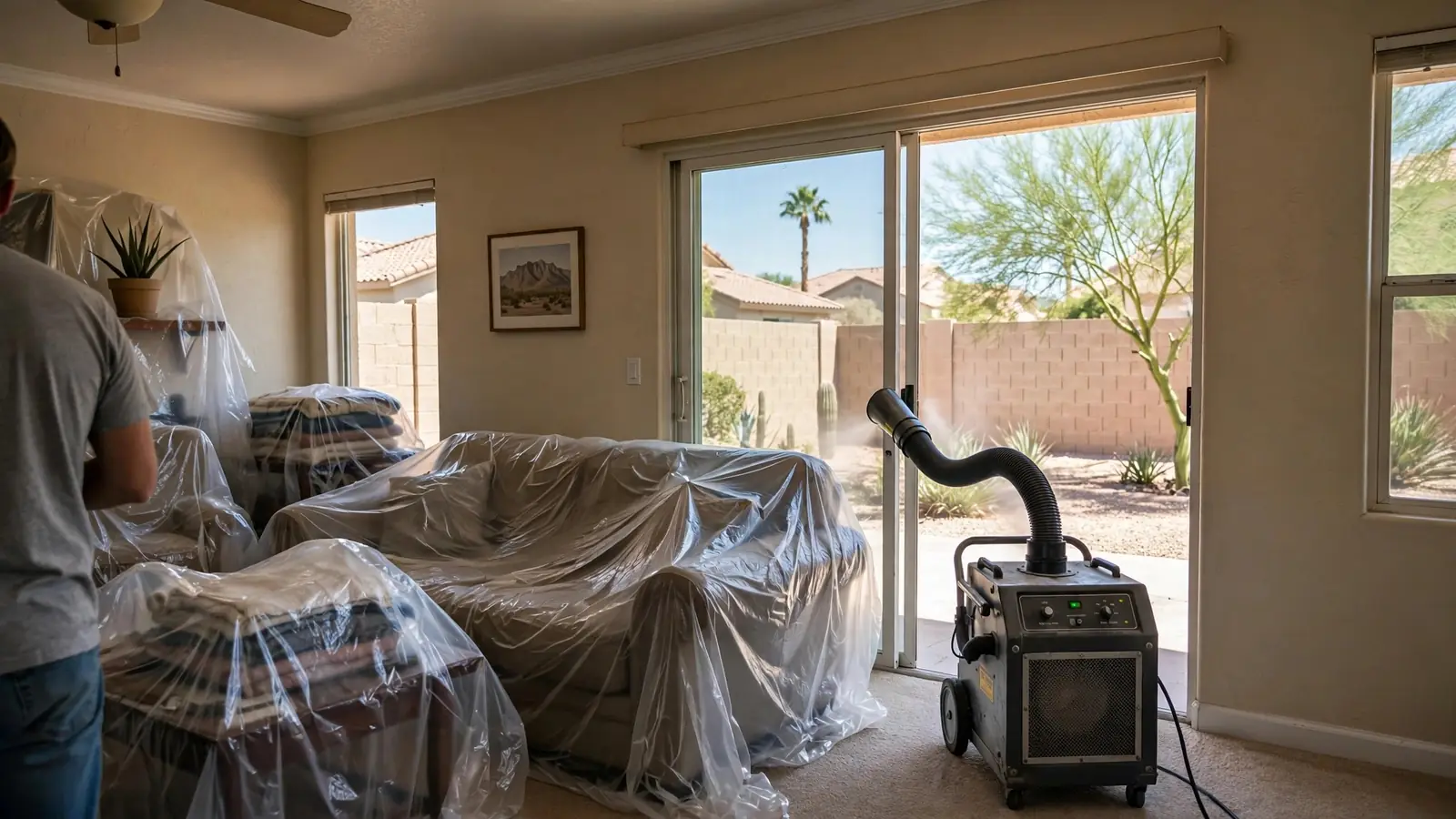
Cleanup begins with air. Air scrubbers with HEPA filters are placed in affected rooms to capture particles disturbed during work. This protects the workers and you, and prevents residue drifting into rooms already cleaned. Where it is safe, a crew may also ventilate to bring fresh air in, although in a Phoenix summer that has to be balanced against heat and dust.
Structural cleaning follows a top-down sequence: ceilings, then walls, then trim, cabinets, fixtures and floors. Dry methods come first to lift loose residue, followed by cleaning solutions matched to the residue type. Hard surfaces such as tile, glass and metal are cleaned and, where acidic residue has started to etch, polished or treated. Fixtures that have pitted may need replacing.
Contents are sorted into three groups. Items that can be cleaned on site, items that need off-site specialist cleaning, and items that cannot be saved. Soft goods such as clothing, curtains and bedding often go to cleaning facilities equipped for smoke. Furniture is cleaned according to its upholstery and frame. Documents and photographs may need specialist handling. Everything that is discarded is listed and photographed first.
The HVAC system is often the last major step. If smoke was in the system, ducts, registers and the air handler are cleaned, and the filter is replaced. Running a contaminated system after cleaning the rooms would undo much of the work. Finally, odor treatment and any sealing, painting or refinishing complete the job.
Contents
How different belongings are usually handled
| Item | Usual approach | Notes |
|---|---|---|
| Clothing and linens | Specialist laundering or dry cleaning | Do not run through a home washer first |
| Upholstered furniture | Cleaning and deodorising | Foam cushions may need replacement |
| Hard furniture | Cleaning and refinishing if needed | Wood finishes can cloud from residue |
| Electronics | Inspection before power-on, specialist cleaning | Residue can corrode circuits |
| Dishes and kitchenware | Hand or ultrasonic cleaning | Discard exposed food |
| Books and papers | Specialist cleaning or freezing if wet | Photograph important documents |
| Rugs and carpet | Cleaning or replacement | Pad usually replaced if smoke-soaked |
Do it yourself?
Smoke cleanup you can safely start
Once the fire department has cleared you to enter, you can take a few useful steps. Photograph every room before anything is moved. Open windows briefly if outdoor air quality is acceptable, turn off the HVAC fan, and replace the filter. Remove perishable food and anything in the refrigerator if the power was off. Bag clothing you need immediately and take it to a cleaner experienced with smoke.
Avoid scrubbing walls, using scented sprays to cover the smell, running ozone generators yourself or powering up electronics. [4] Ozone in particular can harm lungs and should only be used by trained technicians in an unoccupied home, if at all.
- Photograph before moving anything
- Turn off the HVAC fan
- Replace the filter
- Throw out exposed food
- Skip air fresheners and DIY ozone
The visit
What to expect from a smoke cleanup visit
Expect questions first. A contractor will want to know where and when the fire started, how long it burned, whether the air conditioning or evaporative cooler was running, and whether water was used to fight it. Having your insurance claim number handy, if you have one, helps them document the job the way your adjuster expects.
The walk-through usually covers every room, the garage, the attic if accessible, and the HVAC equipment. You can ask the contractor to explain what they are looking at as they go. A clear contractor will point out residue and smell, explain whether each area needs cleaning, sealing or removal, and tell you which belongings they recommend packing out.
Once work begins, ask for a simple schedule and a contact person. Smoke cleanup in an occupied home is disruptive; some families stay elsewhere for part of it. If you stay, ask which rooms will be sealed off and when.
Phoenix specifics
Smoke damage in the Phoenix climate
Phoenix heat changes how smoke damage behaves. Indoor temperatures in a closed house without cooling can climb high enough to soften plastics and drive residue further into surfaces. Odor compounds release more readily in heat, so a smell that seemed manageable on a cool morning can be overpowering by mid-afternoon. Getting cooling and air filtration working, safely, is often an early priority.
Phoenix homes also face smoke from outside. Brush and wildland fires on the edges of the Sonoran Preserve, South Mountain and the McDowell Mountains, and seasonal wildfire smoke from across Arizona, can push smoke into homes that had no fire at all. Homes with evaporative coolers pull large amounts of outside air through the house and can be especially affected. Cleanup for exterior smoke usually focuses on HVAC filters, ducts, fabrics and odor rather than structural repair.
Many Phoenix homes have tile roofs over foam or felt underlayment, open attic spaces and flexible ducts running through the attic. Smoke in the attic is common after any significant interior fire, and it settles into blown-in insulation. Replacing affected insulation is a frequent part of smoke cleanup here.
Prevention
Limiting smoke damage next time
- Working smoke alarmsAlarms in every bedroom, outside sleeping areas and on every level give early warning so a small fire is caught before smoke spreads.
- A fire extinguisher in the kitchenA small cooking fire put out quickly produces far less smoke than one that spreads to cabinets.
- Know your HVAC shutoffTurning off the air handler during a fire, once everyone is safe, limits how far smoke is pushed through the home.
- Close doors at nightClosed interior doors slow the spread of smoke and heat between rooms.
- Change filters on scheduleA clean, well-fitting filter captures more particles during everyday use and smoke events.
Clean or replace
Deciding what smoke-damaged items to keep
For most belongings the question is whether cleaning will return the item to a usable, odor-free state. Hard non-porous items nearly always clean well. Porous items depend on how long they were exposed and how heavy the residue is. Sentimental items such as photographs and heirlooms are worth discussing with a contractor even if they look badly affected, as specialist cleaning can sometimes recover them.
Health and safety come first. Food, medicines and cosmetics exposed to smoke or heat should be discarded. Mattresses and pillows that absorbed heavy smoke are usually replaced. Anything that is heat-damaged, melted or charred is generally not worth cleaning. Keep a list and photographs of everything you discard.
Related problems
Other damage that often comes with smoke
Heavy soot near the fire
Black carbon deposits close to the source need their own cleaning methods.
Read morePersistent odor
Smell that survives cleaning needs deodorisation at the source.
Read moreWet drywall and floors
Water used by firefighters must be dried before smoke cleanup is complete.
Read moreOpen windows and roof holes
Openings let dust and weather in and should be secured quickly.
Read more
Smoke types
Why some fires leave far more smoke residue
Two fires of the same size can leave very different smoke damage. A fast, hot fire that burns with plenty of air consumes more of its fuel and produces less residue, though that residue may travel widely on the strong convection currents. A slow, smouldering fire starved of oxygen, such as a couch cushion or a stack of stored boxes burning for a long time before anyone notices, produces dense, heavy smoke loaded with partly burned material. That second kind usually does more damage to the rest of the house.
The material burning matters too. Wood and paper produce a lighter, drier residue that is relatively easy to clean. Synthetic foams, plastics, vinyl and carpet produce oily, sticky smoke that clings to walls and fabric and carries strong odor. Electrical fires often involve plastic insulation and can leave a sharp, acrid smell. Kitchen fires involving food leave a thin but stubborn residue with a very persistent smell.
When you call, it helps to describe what burned and roughly how long it burned before it was put out. Those two facts let a contractor estimate how far the smoke likely travelled and what kind of cleaning it will need, even before they see the house.
Records
Keeping track of smoke-damaged belongings
Smoke damage touches a lot of small items, and it is easy to lose track of what was cleaned, what was thrown away and what is still in storage. Before anything leaves the house, ask the contractor how they will inventory contents. Many use room-by-room lists with photographs and box numbers, so you can find a particular item later and so your insurer can see what was affected.
Keep your own simple list as well. Note anything with sentimental value, anything you want returned first, and anything you believe was damaged but may not be obvious, such as clothing stored in a closet near the fire. When cleaned items come back, check them in a warm room; if they still smell of smoke after warming up, they may need a second treatment.
Garage fires
Smoke from an attached garage fire
Garage fires are common and produce some of the worst smoke. Garages hold vehicles, fuel, paint, solvents, plastic storage bins and tools, so the smoke is often oily and chemical. In many Phoenix homes the garage is attached, sharing a wall and sometimes an attic space with the living area, and the door between garage and house is the main route for smoke into the home. Smoke from a garage fire frequently affects the laundry room, kitchen and hallway nearest that door, and can travel through the shared attic to bedrooms.
FAQ
Phoenix smoke damage questions
How far can smoke travel inside a house?
Through the whole house in many cases. Smoke moves under pressure through gaps, wall cavities, the attic and the duct system, so rooms far from the fire can be affected.
Can smoke damage happen without a fire in my home?
Yes. Smoke from a nearby house fire or a brush fire can enter through windows, vents and evaporative coolers and leave odor and residue.
Is it okay to turn the AC on after smoke damage?
Not until the system has been checked. If smoke reached the ducts, running it spreads residue to clean rooms. Turn the fan off and replace the filter.
Do air fresheners help with smoke smell?
They mask the smell briefly but do not remove it. Odor comes from residue in porous materials and has to be cleaned or neutralised at the source.
Is it safe to stay in a smoke-damaged house?
That depends on the extent of damage and your health. The fire department will say whether the home is safe to enter. Sensitive people should avoid affected areas until cleaned.
Can smoke damage electronics?
Yes. Residue can be acidic and conductive, causing corrosion and short circuits. Do not power on electronics until they are inspected.
What is the difference between smoke damage and soot?
Soot is heavier carbon residue usually near the fire. Smoke damage includes the lighter residue, staining and odor spread throughout the home.
Will my insurance cover smoke cleanup?
Many homeowner policies cover smoke damage from a covered fire, but coverage varies. Check your policy and talk with your adjuster.
How do I know the cleanup worked?
Surfaces should look clean, the home should not smell of smoke on a hot afternoon, and the HVAC system should not release odor when it starts.