
Key facts: Laveen
- Laveen Village is an urban village in southwest Phoenix, west of South Mountain and south of the Salt River.
- Laveen was long an agricultural area, known for dairies and farms, before large-scale subdivision growth from the early 2000s.
- Much of Laveen's housing is stucco over wood frame built in the 2000s and 2010s, with many two-storey plans.
- Rural properties with horses, barns and outbuildings still exist alongside newer subdivisions.
- The covered ZIP codes for Laveen on this site are 85339 and 85041.
Covered area
Laveen ZIP codes covered by this line
Calls from these Laveen ZIP codes can be connected to an independent restoration contractor serving the area.
- 85339Laveen proper, including the subdivisions and rural properties west of 51st Avenue and south toward the Gila River Indian Community boundary.
- 85041Eastern Laveen and the neighboring south Phoenix areas toward South Mountain.
About Laveen
How Laveen grew and why it matters after a fire
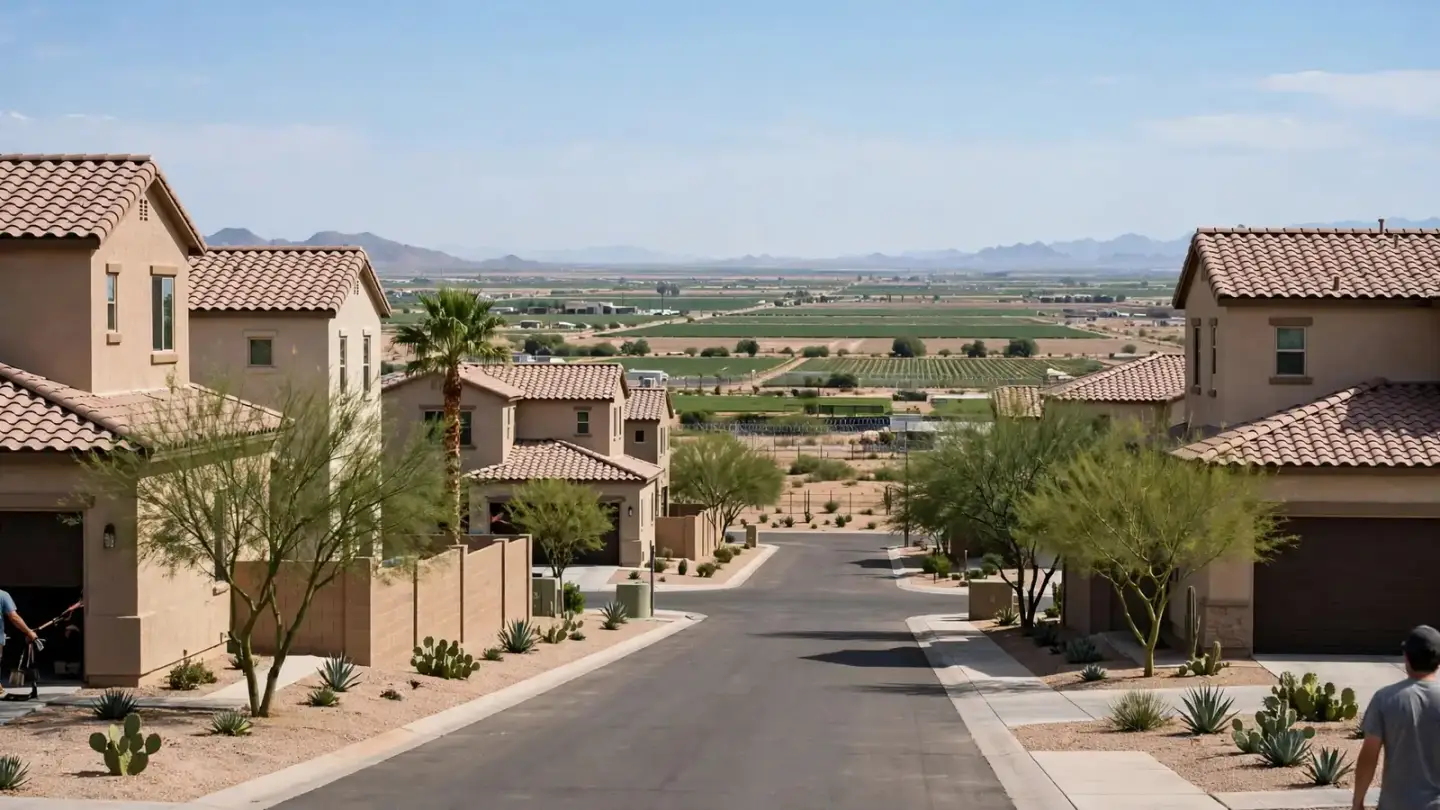
For most of the twentieth century Laveen was farm country on the southwestern edge of the Valley: dairies, cotton and alfalfa fields, irrigation canals and scattered farmhouses, with South Mountain rising to the east. Large-scale housing arrived in the early 2000s, and in a short time thousands of new homes filled former fields. Growth continued after the Great Recession, and the Loop 202 South Mountain Freeway, opened along Laveen's eastern edge in 2019, connected the area more directly to the rest of the Valley.
The result is a community where most homes are relatively new, built by production builders in the 2000s and 2010s, but where open land, working farms, horse properties and canals remain nearby. Subdivisions sit next to fields, and dirt roads and irrigation ditches run behind block walls.
This mix shapes what happens after a fire. Most Laveen houses are modern stucco-over-frame homes with large attached garages, open floor plans and many two-storey layouts. Rural properties add barns, hay storage, workshops and older farmhouses. Dust and smoke from agricultural activity and open land are part of the background.
Construction
Laveen construction details that affect restoration
Two- and three-car attached garages
Large garages share walls and attic space with the house, so a garage fire's smoke reaches living areas quickly.
Two-storey production homes
Upstairs fires send water down through floor cavities; downstairs fires send smoke up open stairwells.
Open-plan great rooms
Kitchen, dining and family areas share one space and one smoke cloud.
Concrete tile roofs and stucco
Standard Valley materials that need specific board-up and tarping methods.
Flexible ductwork in attics
Builder ductwork in hot attics holds smoke odor and is often replaced after heavy exposure.
Rural barns and outbuildings
Hay, feed, fuel and equipment burn intensely and can smoke out a nearby house.
Garage fires
Why garage fires hit Laveen homes hard
Garages in Laveen's newer homes are large and often packed. They hold vehicles, second refrigerators and freezers, workbenches, power tools, lawn equipment, fuel cans, paint, pool chemicals and stacks of plastic storage bins. Many now also hold electric vehicle chargers or battery-powered equipment on charge. A fire that starts in that environment burns hot, and the smoke is oily, dark and chemical.
Building codes require a fire-resistant separation between an attached garage and the house, typically a rated drywall layer on the shared wall and ceiling and a solid or rated door. That separation slows fire, but smoke still finds gaps: around the door, through penetrations for pipes and wires, and into the attic. In many Laveen floor plans the garage door opens into a laundry room, mudroom or kitchen, and a bedroom or bonus room sits directly above the garage. Those spaces usually take the heaviest smoke.
Restoration after a garage fire starts with clearing the garage. Damaged contents need to be sorted and removed so the structure can be assessed. Batteries, fuel and chemicals need careful handling and should not be moved until the fire department and contractor say it is safe. Then the shared wall, the ceiling above, the attic and every adjoining room are inspected for smoke and heat damage.
What you might see
Laveen fire damage clues and causes
| What you notice | Likely reason | What to ask |
|---|---|---|
| Dark film in laundry and kitchen | Garage fire smoke through the house door | Has the shared wall cavity been checked? |
| Smoke smell in bedroom over garage | Smoke through the garage ceiling and attic | Is the floor above the garage affected? |
| Soot upstairs after a downstairs fire | Smoke rose through the open stairwell | Will upstairs rooms be cleaned too? |
| Sagging ceiling downstairs | Firefighting water from an upstairs fire | Will the ceiling be opened to dry? |
| Dust mixed with soot | Open fields and dirt roads nearby | How will surfaces be vacuumed first? |
| Smoke smell after field burning nearby | Outside smoke drawn into the house | Should filters and ducts be cleaned? |
Two storeys
Smoke and water in Laveen two-storey floor plans
Many Laveen homes have an open entry or family room that rises two storeys, with a staircase and an open loft or landing above. These layouts move smoke from a downstairs fire straight to the upper floor. Bedrooms upstairs can be heavily affected even when the fire was in the kitchen, and the residue on upstairs ceilings may be heavier than downstairs.
Water moves in the opposite direction. A fire upstairs, perhaps in a bedroom or the bonus room over the garage, is fought with water that soaks through the floor into the cavity between floors and into the downstairs ceiling. Ceilings can sag or fall. Insulation and wiring in the floor cavity get wet. Drying usually requires opening the lower ceiling, removing wet insulation and running drying equipment until the joists and subfloor reach dry readings.
When you call, describe which floor the fire was on and whether you see stains or sagging on the floor below. That helps the contractor plan for both smoke cleaning upstairs and drying downstairs.
Assessment
What a contractor should check in a Laveen home
- 1
The garage and its connections
The shared wall, the door, the ceiling and the attic above, plus the rooms that adjoin the garage.
- 2
Both floors (Laveen)
Upper floor for smoke that rose through stairwells; lower floor for water that came through the ceiling.
- 3
The attic and ducts
Insulation and flexible ducts along the smoke path.
- 4
The roof (Laveen)
Tile condition and any openings, so tarping can be planned before monsoon storms.
- 5
Outbuildings on rural lots
Barns, sheds and workshops, and their effect on the house.
- 6
Electrical and EV equipment
Chargers, panels and circuits exposed to heat need an electrician's inspection.
Restoration
How restoration usually runs in a Laveen home
Securing comes first: boarding broken windows and garage doors, tarping roof openings on concrete tile, and making sure one entry is lockable. Large garage doors damaged by fire may need plywood panels or temporary fencing to close the opening.
Water extraction and drying follow, with particular attention to floor cavities in two-storey homes and to slab floors under carpet and tile. Wet carpet pad is usually removed. Cabinets in kitchens and laundries next to a garage fire may be both wet and smoky; particleboard boxes often need replacing.
Cleaning and odor work focus on the rooms nearest the fire, the upper floor if smoke climbed the stairs, and the attic. Builder-grade flexible ductwork is commonly replaced rather than cleaned after heavy smoke. Rebuilding then needs City of Phoenix permits, and exterior work in HOA communities needs association approval for colours and materials.
Rural Laveen
Barns, hay and horse properties in Laveen
Laveen still has many larger lots with horses, livestock, barns, hay storage and workshops. Hay can heat up and ignite if stored damp, and barns hold fuel, equipment and bedding that burn quickly. A barn or hay fire produces heavy smoke and can burn for a long time, affecting a house nearby even if flames never reach it.
After an outbuilding fire, check the house for smoke inside, especially if windows were open or an evaporative cooler was running. Check animals for smoke exposure and consult a veterinarian if needed. Debris from a burned barn, including metal roofing, fencing and equipment, needs safe removal.
- Store hay dry and away from the house
- Check the house after a barn fire
- Watch animals for smoke effects
- Clear debris safely
Dust and smoke
Field dust and outside smoke in Laveen
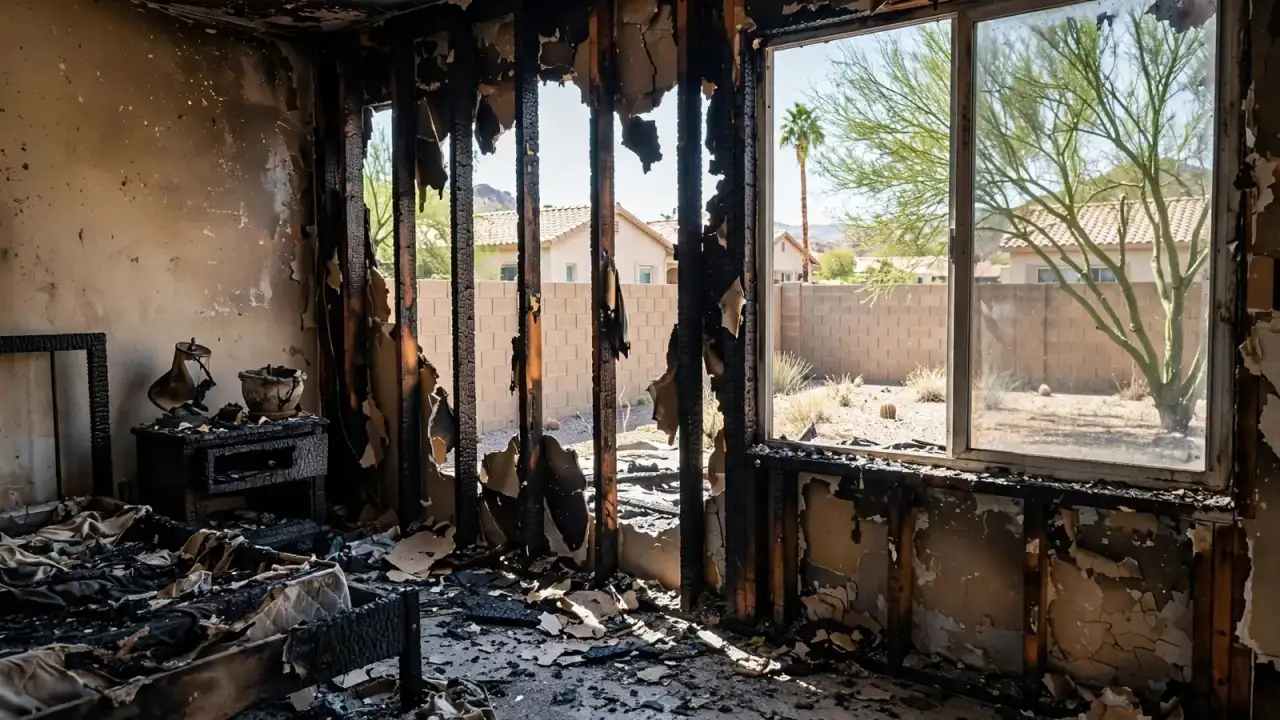
Open land, dirt roads and active farming near Laveen subdivisions mean dust is constant, and dust storms during monsoon season can be intense on the open southwest edge of the Valley. After a fire, dust settling with soot creates a gritty layer that scratches surfaces if wiped. Thorough HEPA vacuuming before any wiping is especially important in Laveen homes.
Smoke from outside sources, such as brush fires on South Mountain, fires in vacant fields or burning of agricultural debris, can also drift into homes. Exterior smoke usually leaves lighter damage, mainly in filters, ducts and fabrics, but it can be enough to leave a persistent smell.
Climate
Laveen summers, monsoon and drying
Summer in Laveen is as hot as anywhere in Phoenix, and a home without power after a fire heats up quickly. Heat makes residue set faster and odor stronger, and it makes working inside without cooling difficult. Restoring safe cooling, or bringing in temporary cooling, is often a priority.
Monsoon storms bring wind, dust and sudden rain. Tarps over fire openings must be fastened well enough to survive strong outflow winds. If your house has an opening and a storm is forecast, mention it when you call.
Prevention
Reducing fire risk in a Laveen home
- Organise the garageKeep fuel, paint and chemicals in proper containers away from heaters, chargers and appliances.
- Charge batteries safely (Laveen)Use manufacturer chargers, avoid charging damaged batteries and do not charge unattended overnight in cluttered spaces.
- Keep the garage-house door closedThe fire-rated door only works when it is shut.
- Store hay properlyKeep hay dry, ventilated and away from the house.
- Alarms on every levelTwo-storey homes need alarms in each bedroom and on each floor, including the bonus room over the garage.
Week one
The first week after a Laveen house fire
- 1
Day 1 (Laveen)
Fire department release, insurer and HOA notified, garage and windows boarded, roof tarped, photos taken.
- 2
Day 1-2 (Laveen)
Garage contents sorted, hazardous items removed safely, water extracted, drying started.
- 3
Day 2-3 (Laveen)
Downstairs ceilings opened where upstairs water soaked through; contents packed out and listed.
- 4
Day 3-5 (Laveen)
Daily moisture readings; attic, ducts and adjoining rooms assessed for smoke.
- 5
End of week (Laveen)
Cleaning, odor and rebuilding scope agreed with the contractor and insurer.
On your call
Questions to ask about your Laveen property
- How will you handle the garage contents?Ask how batteries, chemicals and damaged items will be sorted and removed.
- Will you check the room above the garage?Bonus rooms and bedrooms over garages often take heavy smoke.
- How will you dry between the floors?If an upstairs fire was fought with water, ask how the floor cavity will be dried.
- Can you secure a burned garage door?Large openings need sturdy temporary closure.
- Will you replace the flexible ducts?Heavily smoked flexible ducts are often replaced rather than cleaned.
Services
Restoration services Laveen homeowners ask about
Garage fire smoke
Cleaning smoke from rooms connected to the garage.
Read moreDrying two-storey homes (Laveen)
Drying ceilings and floor cavities after upstairs firefighting.
Read moreSecuring garage openings
Boarding windows, doors and large garage openings.
Read moreSoot and dust (Laveen)
Removing soot mixed with field dust without scratching surfaces.
Read more
Kitchens
Kitchen fires in Laveen open-plan homes
Cooking is the leading cause of home fires nationally, and Laveen's open-plan homes are designed around the kitchen. A large island looks out over the family room and dining area, and often there is no wall or door between the stove and the rest of the ground floor. When a pan of oil catches or food burns on the stove, smoke spreads through that whole open space and up any open stairwell.
Burned-food smoke is especially troublesome. It leaves a thin, sticky, yellowish film that is hard to see but carries a sharp, lasting smell. It coats cabinet faces, the tops of cabinets, light fixtures, window coverings and the ceiling across the open area. Cleaning it requires products designed for protein residue and careful attention to every surface, including inside cabinets if doors were open.
Range hoods in many production homes are recirculating rather than ducted to the outside, which means grease and smoke collect in the hood filter and do not leave the house. After a kitchen fire, hood filters should be replaced and the hood cleaned. If the microwave above the range was involved, it is usually replaced.
Older homes
Older farmhouses and early Laveen homes
Scattered among the subdivisions are older homes that predate Laveen's boom: farmhouses, ranch houses on acreage and modest homes from the mid-twentieth century. These may have older electrical systems, additions built over the years, block or brick walls, and older roofing. Some materials in homes built before the 1980s may contain asbestos, which the U.S. EPA advises testing before disturbance.
Restoration in these homes often needs more investigation than in a newer tract house, because the construction is less predictable. Ask the contractor to look at how the house was built and added onto, test older materials before demolition, and have an electrician check older wiring exposed to heat or water.
Season by season
Laveen fire risks through the year
| Season | Common risk | Helpful step |
|---|---|---|
| Winter | Space heaters, fireplaces, holiday cooking | Keep heaters clear of furniture and bedding |
| Spring | Dry weeds in vacant lots and along canals | Clear weeds near walls within local rules |
| Early summer | Extreme heat stressing equipment and garages | Avoid storing fuel in hot garages near appliances |
| Monsoon | Lightning, wind, dust and roof openings | Tarp openings before afternoon storms |
| Autumn | Holiday cooking and decorations | Stay with the stove when frying |
Neighbors
When a neighboring Laveen house burns
Laveen subdivisions are built close together, often with only side yards and block walls between houses. A fire in one house can crack windows on the neighboring house with radiant heat, scorch stucco and eaves, and push smoke through the neighbor's attic vents, windows and cooling system. Embers can land on nearby roofs.
If the house next door burned, walk around your own home and look at the side facing the fire for cracked windows, melted vinyl, scorched stucco or eaves. Check your attic for smoke smell and replace HVAC filters. Your homeowner's policy may cover smoke and heat damage from a neighbor's fire; ask your insurer and document what you find with photographs.
Canals
Laveen canals, irrigation and drainage after a fire
Irrigation canals and laterals run through and around Laveen, and some properties still receive flood irrigation. After a fire, water from firefighting combined with irrigation or a monsoon downpour can pool against foundations and seep into a house where walls have been opened for drying. If your property is on an irrigation schedule, consider skipping a delivery while the house dries, and make sure yard drainage directs water away from damaged areas.
Debris from a fire, including ash and burned materials, should not be washed into canals or storm drains. Ask the contractor how they will contain and remove debris from the site.
FAQ
Laveen fire restoration questions
Does this line cover Laveen?
Yes. Calls from ZIP codes 85339 and 85041 can be connected to an independent restoration contractor serving Laveen.
Why is the room above my garage so smoky?
Smoke from a garage fire rises through the garage ceiling and attic into rooms above. These rooms often need the most cleaning.
Can my garage door be boarded up?
Yes. Large garage openings can be closed with plywood panels and framing or temporary fencing until the door is replaced.
What should I do with damaged batteries?
Leave them alone. Damaged lithium-ion batteries can reignite. Tell the fire department and contractor so they can be removed safely.
Smoke from a field fire got into my house. Is that serious?
Usually lighter than an interior fire. Replace filters, clean surfaces and fabrics, and have ducts checked if odor persists.
Does my HOA need to know in Laveen?
It is wise to notify your HOA early. Exterior rebuilding usually needs association approval.
Why are there two kinds of damage on different floors?
Smoke rises to the upper floor, and firefighting water flows down to the lower floor. Both need attention.
Do I need permits to rebuild in Laveen?
Laveen is in the City of Phoenix, so regulated repair work needs City of Phoenix permits.
My barn burned but the house looks fine. Should I check it?
Yes. Smoke from a barn or hay fire can enter the house through windows, vents and coolers. Check the attic, filters and fabrics.
Should I pause flood irrigation after a fire?
If irrigation water could reach damaged or opened parts of the house, skipping a delivery while the structure dries is sensible.
Is it safe to charge my electric car after a garage fire?
Not until an electrician has inspected the charger, its circuit and the panel. Heat and water can damage wiring that looks fine from outside.
Will dust from nearby fields make cleaning harder?
It can. Dust mixed with soot is abrasive, so crews vacuum thoroughly before wiping to avoid scratching surfaces.